For many organizations, modernization is still synonymous with large-scale system replacement along with multi-year timelines, high risk, uncertain ROI and operational disruption that teams quietly dread.
But modernization does not have to mean rebuilding everything from scratch.
In fact, some of the most agile enterprises today are moving faster precisely because they didn’t rip out their legacy systems. Instead, they focused on how those systems are exposed, connected, and orchestrated. One of the most effective ways to do this is through API wrapping.
The Myth: Legacy Systems Are the Problem
Legacy platforms whether in telecom BSS/OSS, healthcare EHRs, financial core systems, or ERP environments are often stable, reliable and deeply embedded in business operations.They handle billing accuracy, regulatory compliance, network operations or clinical records at massive scale.
The real issue is not that these systems exist.
Rather we think that the issue is that they were designed for a different era:
- Batch processing instead of real-time interaction
- Point-to-point integrations instead of reusable services
- Rigid interfaces instead of composable access
When modern tools, digital channels, or AI systems need data or actions from legacy platforms, we see friction appear. Achieving agility without system rebuilds requires making these systems accessible without replacing them entirely. Innovation slows not because the core systems are failing, but because they are hard to reach.
What API Wrapping Actually Means
API wrapping is the practice of placing a modern, well-designed API layer around existing systems without changing their internal logic.
Rather than rewriting the core platform, we:
- Expose legacy capabilities (data, workflows, transactions) as APIs
- Translate modern protocols to legacy interfaces
- Enforce security, governance, and observability at the API layer
- Decouple consumers from the underlying system complexity
The legacy system continues doing what it does best. The API layer becomes the contract that the rest of the organization builds on.
This separation is what unlocks agility without system rebuilds.
API Wrapping as an Enabler for AI and Automation
Modern systems, especially agentic and decision-driven architectures depend on fast, reliable access to operational data and actions.
Without API wrapping, AI insights remain disconnected from execution, automation stops at recommendations and real-time decisioning becomes impossible
With API-wrapped systems, Agentic AI can query customer, network, or operational context in real time, decisions can trigger actions across billing, provisioning, care pathways, or service workflows, intelligence becomes operational.
In other words, AI scales only when systems are accessible, and enterprises can truly achieve agility without system rebuilds.
Modernization Is an Architectural Strategy, Not a Rewrite
The most resilient organizations are no longer asking, “How do we replace our legacy systems?”
They’re asking, “How do we make our systems accessible?”
API wrapping answers that question.
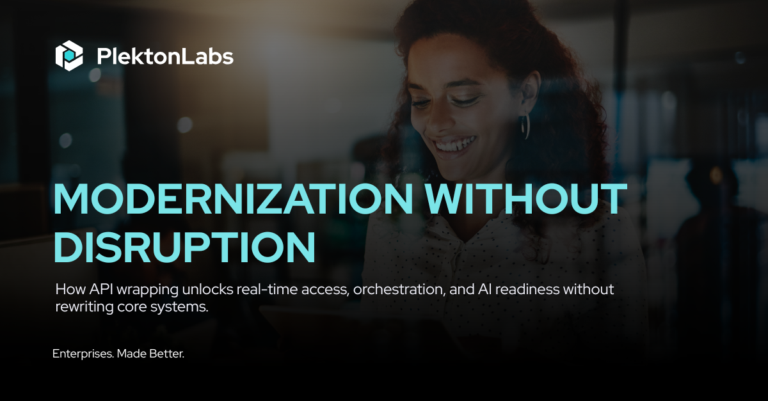
Modernization as an architectural strategy means focusing on connectivity, exposure, and orchestration instead of replacement. By implementing API wrapping for legacy systems, enterprises can modernize incrementally, reduce risk, and enable continuous innovation all without disrupting critical operations.
Agility comes from designing how systems connect, communicate, and evolve.
At PlektonLabs, we help enterprises modernize without disruption.
Our integration and orchestration platforms enable organizations to:
- API-enable legacy systems safely
- Eliminate brittle point-to-point integrations
- Support real-time digital, data, and AI initiatives
- Build architectures designed for continuous change
If your organization needs agility without system rebuilds, let’s talk about how API wrapping for legacy systems can unlock it.